

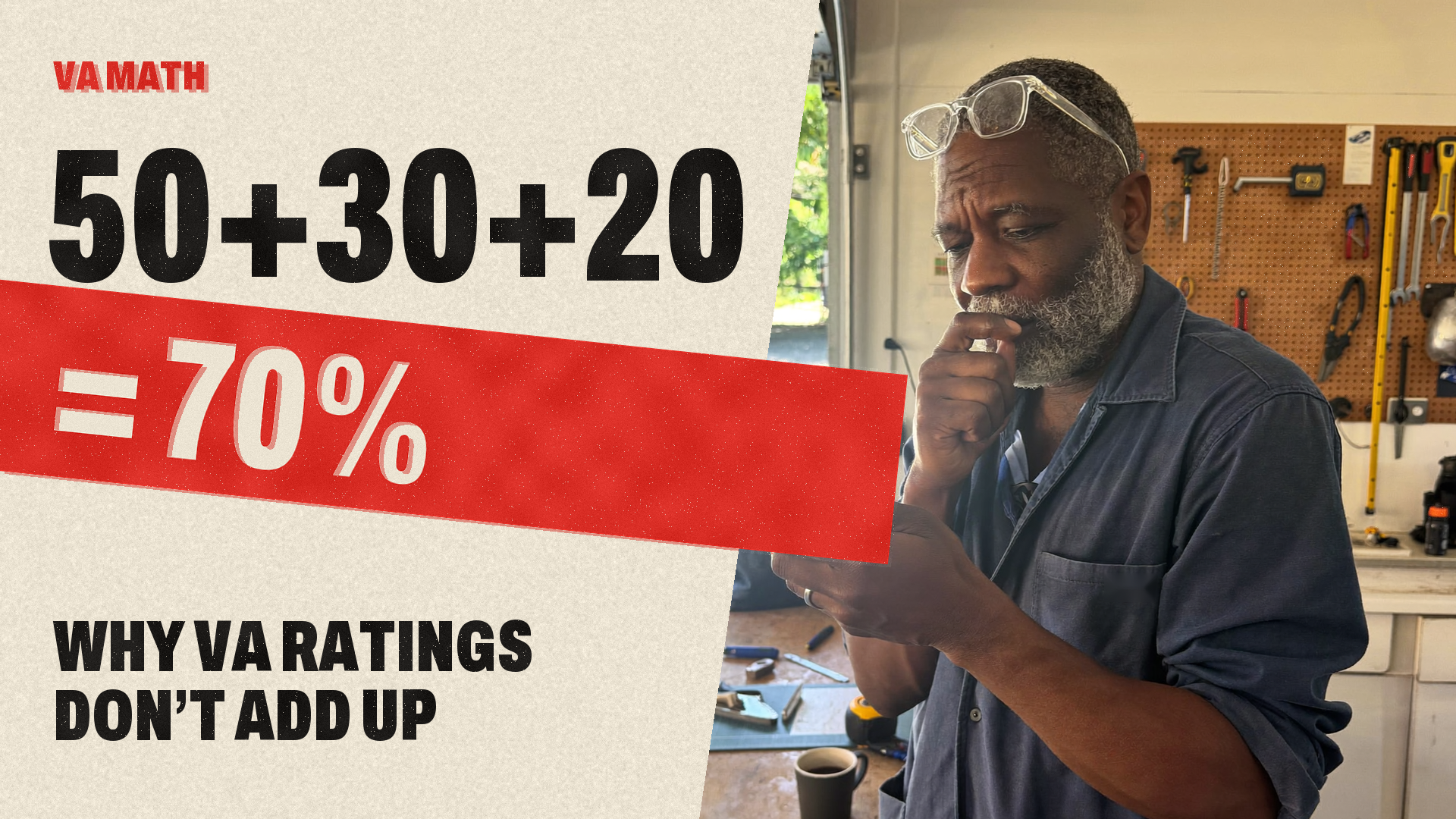
Fifty plus 30 plus 20 looks like 100. Run through VA's method, those same three ratings come out to 70%. This guide shows why, step by step, so a combined rating reads as math instead of a mistake.
VA doesn't add your ratings. It combines them.
Fifty plus 30 plus 20 looks like 100. Run through VA's method, those same three ratings come out to 70%. This guide shows why, step by step, so a combined rating reads as math instead of a mistake.
What VA says
VA's About disability ratings page says it uses a method called the "whole person theory" so your total rating "doesn't add up to more than 100%. That's because a person can't be more than 100% able-bodied." The same page says your combined rating "may be different from the sum of your individual ratings."
Each rating takes a share of what's left
The regulation, 38 CFR 4.25, gives its own example. A person with a 60 percent disability is considered 40 percent efficient. A further 30 percent disability leaves 70 percent of that 40, which is 28 percent efficiency. So the person is 72 percent disabled, not 90.
What this guide covers
How VA combines ratings, a worked example, a practice table, one special rule and where to take questions. It is general education about the public process. It does not check or predict anyone's rating.
Four steps, one example: 50, 30 and 20.
Here is VA's method run on three example ratings. They show how the math works. They are not anyone's rating.
1. Put the ratings in order
VA arranges the ratings from most severe to least, so the highest goes first. Here that means 50, then 30, then 20.
2. Combine the first two
Start from a whole person: 100. The 50 takes half, which leaves 50. The 30 then takes 30 percent of that remaining 50, which is 15. Table I in 38 CFR 4.25 shows 50 and 30 meeting at 65. VA keeps the 65 as it is. No rounding yet.
3. Bring in the next rating
Now combine 65 with 20. The 65 leaves 35. The 20 takes 20 percent of that 35, which is 7. Table I shows 65 and 20 meeting at 72. With more ratings, the unrounded number keeps carrying forward the same way.
4. Round once, at the end
Only now does VA round to the nearest 10. 72 rounds to 70, so the combined rating is 70%. Simple adding said 100.
Same method, different numbers.
Each row runs VA's method on example numbers. The table value comes from Table I in 38 CFR 4.25, before rounding. The last column is that value rounded once to the nearest 10.
Rounding can go down, too
In the regulation's own example, 40 and 20 meet at 52, which rounds down to 50%. Two 50s meet at 75, which rounds up to 80%, not 100.
Round once, at the end. A 5 rounds up.
The regulation says rounding to the nearest 10 happens only once per rating decision, after every rating has been combined, as the last step. A value ending in 5 rounds up, so 65 becomes 70 and 75 becomes 80. Rounding partway through is not part of the method.
One special rule, and where to see yours.
Most ratings combine the way the last two pages show. One rule handles paired limbs differently, and VA gives you a place to see your own numbers.
The bilateral factor (38 CFR 4.26)
In general, when compensable disabilities affect both arms, both legs or paired skeletal muscles, VA handles them first. It combines those ratings, then adds 10 percent of that value. That 10 percent is added, not combined. The result is treated as one disability in the regular order. The rule has conditions and an exception, so read 38 CFR 4.26 or ask accredited help how it applies.
Where to see your own ratings
If you have filed a claim and have an assigned rating, VA says you can sign in to VA.gov to view your individual ratings and your combined rating (VA's View your disability ratings page). VA's About disability ratings page explains this same method and has a calculator you can use to check the math. The calculator shows how combining works. It does not decide anything.
The number VA uses
VA says it uses your disability rating "to determine your disability compensation rate." That is the combined rating, not the sum of the separate ratings.
Questions about your rating go to accredited help.
This guide explains the method. It cannot check how a rule applies to your ratings. Accredited representatives are authorized to help with an individual claim.
Free accredited help
VA says the services an accredited Veterans Service Organization (VSO) representative provides on your claims are always free. Accredited attorneys and claims agents can charge fees. Use VA's Find a VA accredited representative or VSO tool before you appoint anyone.
Questions worth bringing
In what order were my ratings combined, and how did VA get my combined rating? Does the bilateral factor apply to any of them? Where does my decision letter show each rating? If a number looks wrong to me, what can I do about it?
What you control
Get diagnosed and treated, so your records show each condition and how it affects your daily life. At any exam, describe your real symptoms accurately: not bigger, not smaller. No one can promise a rating or a combined percentage. VA decides.
Sources behind this guide
- 38 CFR 4.25: combined ratings table (eCFR)
- 38 CFR 4.26: bilateral factor (eCFR)
- VA.gov: About disability ratings (includes VA's calculator)
- VA.gov: View your disability ratings (sign-in required)
- VA.gov: Get help from a VA accredited representative or VSO
- VA.gov: Find a VA accredited representative or VSO
Your next step
Your health,
in one clear picture.
You can start with your own care team, or let us coordinate it.
VHN Membership starts with a Clinical Baseline: every record we can find, and a full evaluation of your physical and mental health. Then a Care Advocate helps you navigate your care.
See if VHN is right for you ↗