

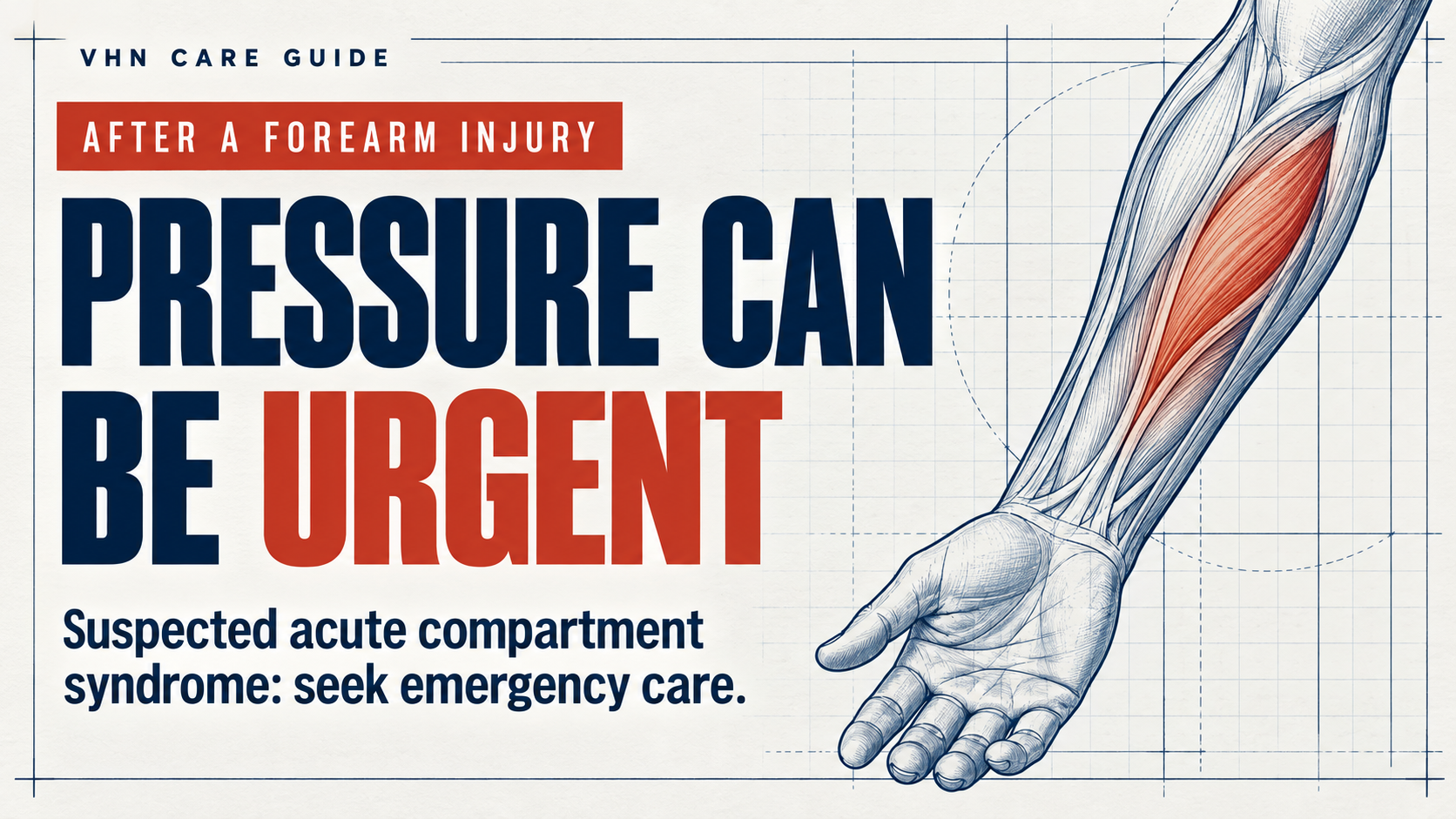
Suspected acute compartment syndrome is a medical emergency. Go to an emergency department immediately. Do not use a worksheet or a comment reply to decide whether to seek care.
After an injury, do not wait this out.
Suspected acute compartment syndrome is a medical emergency. Go to an emergency department immediately. Do not use a worksheet or a comment reply to decide whether to seek care.
What can raise concern
Pain more severe than expected after an injury and a tight or full-feeling muscle can occur in acute compartment syndrome. Symptoms alone do not establish the diagnosis. A clinician must assess the situation.
Do not wait for late signs
Numbness and paralysis are late signs. Their absence does not rule out a dangerous pressure problem. Do not stretch, squeeze or repeatedly test an injured arm to see whether it matches a post.
What this guide is for
The first page explains the urgency. The remaining pages explain the mechanism and help organize a conversation after urgent assessment. This is not a home diagnostic checklist.
Swelling can restrict the blood supply.
Muscles, nerves and blood vessels sit inside compartments enclosed by fascia, a relatively unyielding tissue layer.
The mechanism
Swelling or bleeding inside a compartment can raise pressure enough to reduce blood flow to muscles and nerves. Without prompt treatment, tissue damage can occur. A small-looking external injury does not reliably show the pressure inside.
How an injury can relate
Acute compartment syndrome can follow severe trauma, fractures, crush injuries or a badly bruised muscle. Arms can be affected. This does not mean every forearm injury causes it.
A different condition from exercise-related pain
Chronic exertional compartment syndrome is a different presentation. Do not use exercise-related information to reassure yourself about a new, severely painful injury. The urgent advice here concerns suspected acute compartment syndrome.
Keep the timeline. Keep the instructions.
After you have received urgent care, organize the facts for the treating team. Follow their discharge and return instructions.
Injury and treatment
Record the date and mechanism of injury, when pain or tightness changed, where you were assessed and what treatment occurred. Bring imaging, operative or discharge reports if available.
Current function
Describe what is still difficult: gripping, turning a key, lifting, finger movement or other activities you actually do. Say what you changed or needed help with. Do not perform painful tasks to prove a limitation.
A concrete example
Illustrative language: use only if true: “Since the injury, I need help opening the garage door because my grip gives way.” Add when this began, how often it happens and whether it is improving or worsening. This does not establish a diagnosis or rating percentage.
What should improve? What needs a recheck?
A clear follow-up plan is more useful than guessing which tissue is responsible for a symptom.
Questions for the treating team
What was the diagnosis? Were muscles or nerves affected? What activity restrictions apply? Which changes require urgent reassessment, and who should I contact?
Records and clinical findings
Ask whether your record accurately describes the injury, treatment, findings and continuing functional changes. Symptoms after an injury do not, by themselves, prove a secondary medical relationship.
Keep the claims question separate
This packet uses forearm muscle injury as a topic anchor. It does not assign a muscle group, disability percentage or service connection from the symptom. Clinicians establish findings; accredited representatives can help with claims questions.
Sources behind this guide
Control the foundation
Your health is where
the evidence begins.
You can start with your care team. Or let us coordinate it.
VHN brings veteran-focused independent care, records, appointments and follow-up into one coordinated process. Your case manager keeps the moving pieces connected.
See if VHN is right for you ↗