

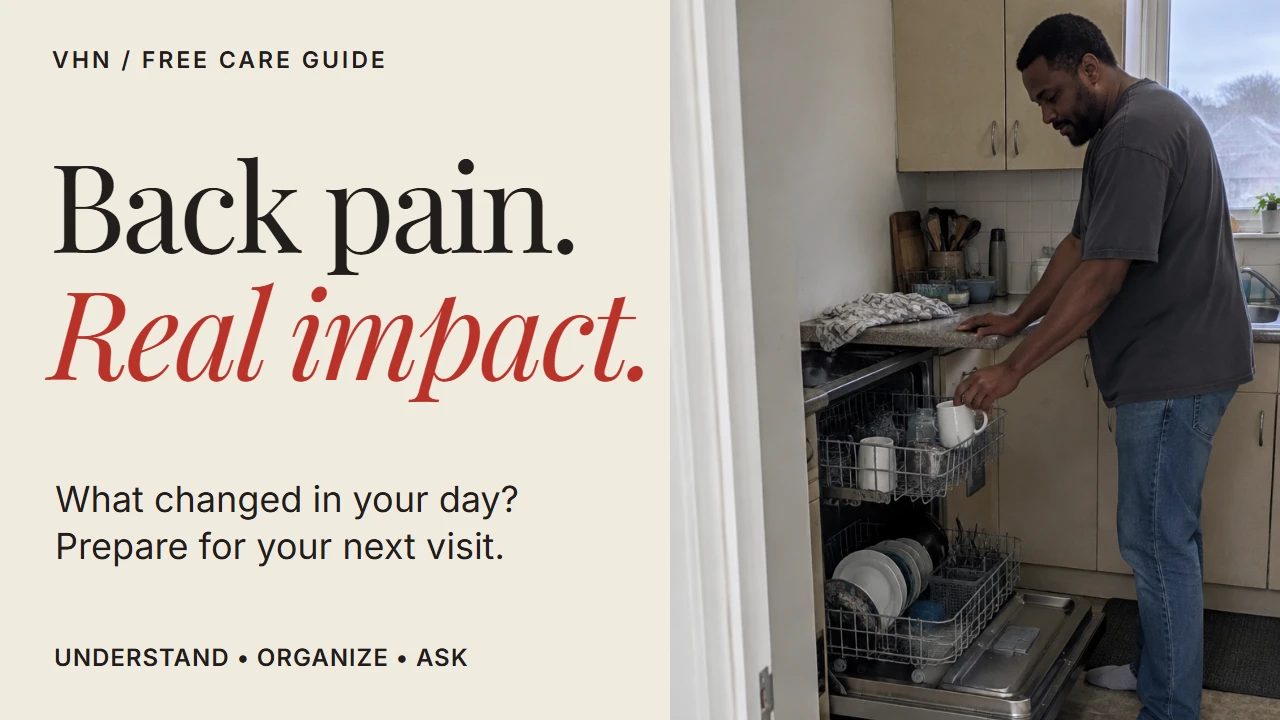
Prepare for a useful conversation about back symptoms, movement and the activities that have changed. Use this guide with the care team you already have.
Help your clinician see the day between visits.
Prepare for a useful conversation about back symptoms, movement and the activities that have changed. Use this guide with the care team you already have.
Start with what you know
Spondylolisthesis means one vertebra has slipped relative to the one below it. A symptom alone does not confirm that diagnosis. Bring the diagnosis and imaging report you have; ask your clinician what the findings mean for you.
A different question from slip grade
A scan describes structure. VA’s general spine formula considers measured motion, ankylosis and other specified findings, together with applicable functional-loss rules. The slip grade does not translate directly into a VA percentage.
What this guide helps you do
Describe your ordinary days and flares. Organize treatment and relevant records. Understand the lower-back rating branches. Ask for the next care step and correct factual errors in your record. Education cannot predict your individual rating.
Give the pattern. Then one real example.
Useful details explain what happens, how often it happens and what changes. You do not need to measure your own back angle.
Describe ordinary days and flares
Where do you feel symptoms? When did they begin? How often do symptoms worsen, how long does that last, and what seems to bring it on? Explain what your movement or activity is like during a flare compared with a usual day. Label estimates as estimates.
Show what you changed
Illustrative language: use only if true: “Yesterday I stopped loading the dishwasher after a few minutes. My partner finished. I sat down until the pain eased.” Add how often that occurs. A daily-life example is evidence of impact, not a percentage threshold.
Mention symptoms beyond back pain
Tell your clinician about leg pain, numbness, tingling, weakness or walking changes if present. Report what you observe without deciding which nerve or diagnosis explains it. Associated objective neurologic abnormalities may be evaluated separately by VA.
Your experience. Your clinician’s findings.
Both belong in the conversation. They are different kinds of information.
Movement is measured clinically
Forward flexion means bending forward. Combined range of motion adds six movements: forward bend, backward bend, both side bends and both rotations. The VA back questionnaire records motion, pain and functional impact. Do not push through pain or perform a home rating test.
Explain repeated use and flares
Describe what changes after repeated activity and during a flare, including frequency, duration and what you cannot do. A visit on a better day does not erase that history. The examiner considers available information when assessing additional functional loss.
A fixed region is different from stiffness
Ankylosis is fixation of a joint or region. The rating formula’s higher branches refer to the entire specified spinal region. Pain or stiffness alone is not enough. In some cases, functional loss during flares may amount to the functional equivalent of ankylosis; that requires an evidence-based assessment, not self-labelling.
10% and 20%: alternative findings.
DC 5239 uses the General Rating Formula for Diseases and Injuries of the Spine. These are the thoracolumbar (mid- and lower-back) branches, not the neck criteria.
10%: any listed alternative
Forward flexion greater than 60° but no greater than 85°; OR combined motion greater than 120° but no greater than 235°; OR muscle spasm, guarding or localized tenderness without abnormal gait or abnormal spinal contour; OR a vertebral-body fracture with loss of at least 50% of height. The fracture clause is a general-formula alternative, not a usual feature of spondylolisthesis.
20%: any listed alternative
Forward flexion greater than 30° but no greater than 60°; OR combined motion no greater than 120°; OR muscle spasm or guarding severe enough to cause abnormal gait or abnormal spinal contour, such as scoliosis, reversed lordosis or abnormal kyphosis.
What the numbers mean
The forward-bend range and the combined-motion total are different measurements. “OR” matters: a qualifying alternative can apply without all the others. Guarding means protective restriction of movement; the required effect on walking or spinal contour distinguishes these branches.
40%, 50% and 100%: which region is fixed?
The amount and type of fixation matter. These percentages are not labels for how painful an ordinary day feels.
40%
Forward flexion of the thoracolumbar spine 30° or less; OR favorable ankylosis of the entire thoracolumbar spine. Fixation in neutral position (0°) is always favorable under Note 5.
50%
Unfavorable ankylosis of the entire thoracolumbar spine. Note 5 requires fixation in flexion or extension plus at least one specified consequence: limited-line-of-vision walking difficulty; restricted mouth opening and chewing; breathing limited to diaphragmatic respiration; gastrointestinal symptoms from pressure of the costal margin on the abdomen; dyspnea or dysphagia; atlantoaxial or cervical subluxation or dislocation; or neurologic symptoms due to nerve-root stretching.
100%
Unfavorable ankylosis of the entire spine: this includes the neck, not only the lower back. There is no 30% or 60% rung in this lower-back general-formula sequence. Other codes or evaluation routes have their own requirements.
Leave with a clear next step.
Bring a short summary rather than trying to remember every detail during the visit.
Bring what you already have
Relevant visit notes and imaging reports; a medication list with your actual use; therapies, procedures or supports you have tried; what helped, what did not and concerning effects. Do not stop or change treatment to influence an examination.
Ask useful questions
“Do these symptoms need further evaluation?” “What should I do if the symptoms change?” “What is our treatment or follow-up plan?” “Does the note accurately reflect the examples I shared?” Your clinician determines which examination, imaging or referral is appropriate.
Check facts after the visit
Review available notes for accurate symptom history, medicines and reported daily limitations. If a fact is wrong, contact the care team with the specific correction. A clinical assessment may differ from your interpretation. New loss of bladder or bowel control, numbness around the groin or rapidly worsening weakness needs urgent medical evaluation.
Your next example.
Print this page or copy the prompts into your own notes. Write what actually happened. Leave a detail blank if you do not know it.
When did it happen?
Date, approximate time and duration. Say if you are estimating.
What were you doing?
Name the activity and what symptoms you noticed.
What changed?
What did you stop, adjust or need help doing?
How often? What helped?
Usual pattern, flare pattern and response to your usual care.
What do you want to ask?
One question to bring to the appointment.
Read the source. Keep the scope clear.
Prepared September 22, 2026. This is general education for a provider conversation, not a diagnosis, individual legal advice or a promised VA result.
Rating and examination sources
38 CFR §4.71a, DC 5239 and the General Rating Formula, including Notes 1 to 6; §§4.40, 4.45 and 4.59 for applicable functional-loss and painful-motion principles. The VA Back (Thoracolumbar Spine) DBQ is version 24_4, updated December 20, 2024.
Interpretation and health information
Chavis v. McDonough (2021) addresses the functional equivalent of ankylosis in an appropriate case. NIAMS Back Pain provides clinical background and symptoms requiring prompt assessment. NHS Back Pain supports the urgent symptom guidance.
What remains individual
Service connection, the full record, applicable rules and VA adjudication determine the result. Associated objective neurologic abnormalities may receive separate evaluation under an appropriate code. This guide does not calculate a combined rating or substitute the IVDS incapacitating-episode formula.
Sources behind this guide
Control the foundation
Your health is where
the evidence begins.
You can start with your care team. Or let us coordinate it.
VHN brings veteran-focused independent care, records, appointments and follow-up into one coordinated process. Your case manager keeps the moving pieces connected.
See if VHN is right for you ↗